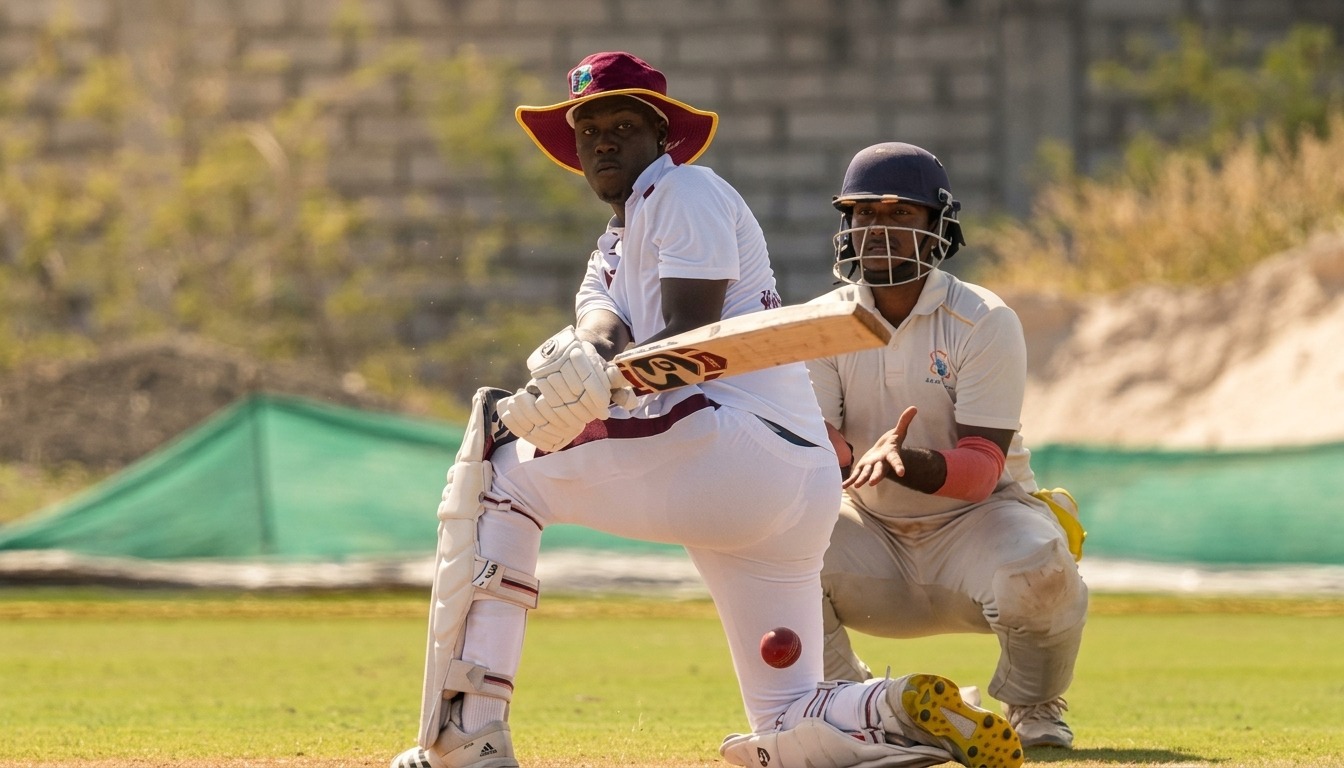

Maaz Sadaqat could be a new solution for Pakistan’s T20 batting.
97 Repoter: 97 Admin
Publish : 1 hour agoUpdate: 1 minute ago
Maaz Sadaqat could be a new solution for Pakistan’s T20 batting.
Maaz Sadaqat could be a new solution for Pakistan’s T20 batting.
The lack of aggression in Pakistan’s T20 batting is not a new issue. Even when the team manages to put together substantial totals, a slow start during the powerplay, excessive caution early on, and a failure to capitalize on scoring opportunities have repeatedly cost them. This recurring problem has even led to the exclusion of otherwise reliable batters like Babar Azam and Mohammad Rizwan. Now, young left-handed batter Maaz Sadaqat has emerged as a promising solution to address this deficiency.

Why is Maaz Sadaqat the talk of the town?
Among batters who have scored at least 1,000 runs in T20 cricket, only 22 possess both an average exceeding 30 and a strike rate above 150. Sadaqat is the only Pakistani representative on this list.
Statistics indicate that he possesses the two essential traits for modern T20 batting: the ability to score consistently and the capacity to score quickly. Although his experience in international cricket remains limited, the youngster has already demonstrated his capabilities within a short span of time.
Since making his T20 debut at the Asian Games last month, Sadaqat has played five international matches for Pakistan. Furthermore, his recent performances in franchise cricket have given Pakistan reason for optimism.
451 runs in 8 innings, with a strike rate of nearly 195
Sadaqat has been in sensational form over the past month, accumulating 451 runs across eight innings at a strike rate of 194.39.
In the most recent Caribbean Premier League (CPL), Sadaqat scored two centuries for the Jamaica Kingsmen—remarkably, both came in the tournament’s Eliminator and Final matches. Additionally, in the recent series against Sri Lanka, he scored two half-centuries in his first two T20 appearances for Pakistan, including a knock of 96 runs.
Such consistency points to new possibilities for Pakistan’s top order. Addressing the Openers' Slow Start
Although primarily an opener, Sadiqat batted at number three during the recent series against Sri Lanka. In that series, Sahibzada Farhan and Fakhar Zaman opened the innings for Pakistan. Consequently, it is highly likely that Sadiqat will continue to bat at number three for the time being.
Among all Pakistani opening pairs that have combined for at least 450 runs, none score faster than Fakhar Zaman and Sahibzada Farhan. However, both tend to be cautious at the start of their innings; they typically play the first seven to eight balls with care before shifting to an aggressive approach. This often leads to a slower scoring rate during the first half of the powerplay.
Having Sadiqat at number three would allow Pakistan to compensate for this. Even if the openers face a high number of dot balls, Sadiqat can keep the scoreboard moving by scoring quickly. Conversely, if the openers provide a strong start, he possesses the ability to maintain or even accelerate that momentum.
Therefore, Sadiqat’s presence in Pakistan’s top order is not merely a matter of individual performance; it could also bring a positive shift to the team’s overall batting strategy.
Effective Against Both Pace and Spin
Batting at number three in T20 cricket is no easy task. One must capitalize on the powerplay while also maintaining a healthy scoring rate through the middle overs. If wickets fall, the batter must stabilize the innings; if the situation is favorable, they must continue to press the attack.
To do this, one must be effective against both pace and spin bowling. Sadiqat’s statistics in this regard are promising. Across all forms of T20 cricket, he averages 37.21 against pacers with a scoring rate of 10.39 runs per over. Against spinners, he maintains an average of 37.58 and a scoring rate of 9.44 runs per over.
Such consistent performance against both types of bowling makes him a highly effective option for the number three position. Ability to Play Shots All Around the Ground
Another major strength of Sadaqat’s batting is his skill in playing shots to various parts of the field. He doesn’t rely solely on straight-batted shots or big hits over the mid-wicket region; he also possesses a diverse range of strokes on the off-side.
During his 96-run innings against Sri Lanka, Sadaqat played several elegant shots in front of and behind the point region, utilizing both his front and back foot. In that same innings, he executed a reverse-paddle against a length delivery from Dasun Shanaka—pitched outside the off-stump—sending the ball to the boundary through the gap between the wicketkeeper and short third-man. Later, he also played a ramp shot over short fine-leg against Nuwan Thushara.
The ability to play such shots makes him a formidable opponent for bowlers. Furthermore, by creating opportunities to score in different areas of the ground, he ensures the scoreboard keeps ticking, even under pressure.
Finally, a Solution for the Number Three Spot?
Since the beginning of 2025, Pakistan has fielded 10 different batsmen at the number three position in T20Is across 48 matches, yet they have yet to find a permanent solution for this spot.
Sadaqat’s recent performances offer a potential remedy to this long-standing issue. His batting combines aggression with effectiveness against both pace and spin, complemented by the ability to play shots all around the field. This left-handed batsman has also demonstrated the capacity to adjust the tempo of his innings according to the situation.
However, it would be premature to label him a permanent solution after only five international T20 matches. He will face tougher challenges ahead; opposing bowlers will analyze his batting and devise new strategies against him. If he can overcome these challenges and maintain consistency, Maaz Sadaqat will have the opportunity to cement his place as Pakistan’s number three.